Building a custom home has a funny way of changing your definition of expensive.
At the beginning, you may be thinking about square footage, the kitchen and maybe a nice back porch.
Six months later, you are discussing the price difference between two types of hinges and wondering how you developed such strong opinions about grout color.
That is normal.
A custom home gives you thousands of choices. The trick is not spending the most money everywhere. The trick is spending it where the money actually matters.
Some upgrades affect comfort, durability, and how the house functions every single day.
Others are beautiful but easy to change later.
And a few are the kind of things people save money on once – then pay to fix for the next twenty years.
The best custom-home budget is not the one with the fewest upgrades.
It is the one that knows the difference.
First Rule: Spend More Carefully on Things That Are Hard to Change Later
If there is one principle that should guide a custom-home budget, it is this:
Spend thoughtfully on the things buried in the house. Be more flexible with the things attached to it.
Changing a light fixture later is easy.
Changing where a window is located is not.
Replacing a faucet is manageable.
Fixing poor drainage around the foundation is a different Saturday project entirely.
That does not mean hidden items always need the most expensive option available.
It means they deserve more attention because replacing them later usually involves demolition, disruption, or both.
The less reversible the decision, the more seriously it should be considered before construction.
Where to Splurge: The Building Envelope
The shell of the house is not particularly glamorous, which is unfortunate because it does some of the most important work.
Insulation, air sealing, flashing, waterproofing, roofing details, windows and exterior doors all affect comfort, energy use and durability.
You may never invite a neighbor over to admire your wall assembly.
You will notice, however, if one side of the house is freezing every January.
Good windows and doors can also affect sound, drafts, condensation, maintenance, and how the home feels every day.
This does not mean buying the most expensive window package in the showroom.
It means understanding what you are getting and resisting the temptation to cut deeply into the parts of the house that are difficult to improve after the drywall goes up.
Where to Splurge: HVAC and Comfort
People rarely walk through a finished home and say, “What a beautiful HVAC system.”
They do say:
- “Why is this bedroom always hot?”
- “Why is the upstairs freezing?”
- “Why is the air so humid?”
- “Why can I hear the system kick on from across the house?”
Heating and cooling should be designed around the home, not treated as an appliance that gets dropped in near the end of the build.
Good equipment matters, but so do proper sizing, duct design, zoning where appropriate, return-air strategy and installation quality.
A bigger system is not automatically a better system.
Neither is the cheapest one.
Comfort is one of those things homeowners barely notice when it is done well – and think about constantly when it is not.
Where to Splurge: Windows Where They Matter Most
Windows can become one of the larger line items in a custom home, especially when the design includes oversized openings, specialty shapes or large expanses of glass.
You do not necessarily need the most expensive window in every closet and secondary room.
But in the places where the windows define the architecture – the great room, kitchen, primary suite or a view-facing elevation – they can have an enormous effect on the finished home.
Window placement also matters as much as window price.
A well-placed window can frame a view and transform a room.
An expensive window pointed directly at your neighbor’s garbage cans is still technically an expensive window.
Where to Splurge: The Kitchen Layout Before the Kitchen Finishes
It is easy to spend money on your kitchen!
It is harder to spend it wisely.
Start with the layout.
- How do you cook?
- How many people cook at once?
- Where will groceries enter the house?
- Where will small appliances live?
- How far is the refrigerator from the prep area?
- Can someone open the dishwasher without blocking the entire kitchen?
Those decisions matter more than whether the drawer pulls cost $9 or $29 each.
Good cabinetry is usually worth investing in because cabinets are used constantly and expensive to replace.
But even beautiful cabinetry cannot rescue a kitchen that was poorly planned.
Spend on the bones first.
Then decide how fancy the jewelry needs to be.
Where to Splurge: Sitework and Drainage
This may be the least exciting answer in the entire article.
It is also one of the most important factors.
Water does not care how much you spend on countertops.
Grading, drainage, retaining solutions, driveway design and proper water management can determine whether a beautiful lot remains beautiful after the first several major storms.
Sitework is often one of the places homeowners struggle emotionally because so much money can disappear into dirt.
Unfortunately, dirt can be expensive.
Cutting corners on drainage or grading can lead to erosion, standing water, foundation concerns, landscape problems, and expensive corrections later.
Nobody wants to spend more than necessary on sitework.
But this is not the place to solve a budget problem by simply hoping gravity changes its mind.
Where to Splurge: Lighting Design – Not Necessarily Fixtures
Lighting is another category where planning matters more than price tags.
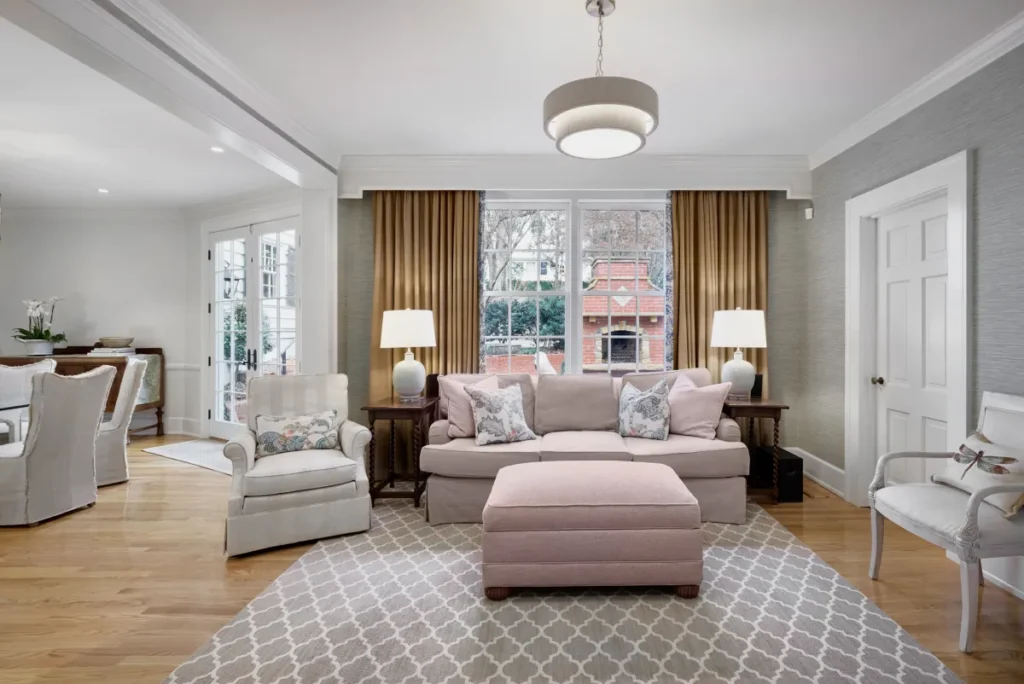
A thoughtful lighting plan considers task lighting, ambient lighting, accent lighting, natural light, and how rooms are actually used.
That might mean under-cabinet lighting in the kitchen, good bathroom lighting, properly placed recessed fixtures, dimmers where they matter, stair lighting, exterior lighting and enough switched circuits to create different moods.
The actual decorative fixtures can be expensive – or not.
Many of those can be changed later.
The difficult part is to change where the boxes, circuits, and switches were installed.
Wire is cheap before drywall.
It becomes considerably more sophisticated after drywall.
Where to Save: Decorative Fixtures You Can Replace Later
This is where homeowners can often recover budget without compromising the house itself.
Decorative light fixtures are a good example.
If the dining-room chandelier you love costs $4,000 and the budget is getting uncomfortable, install something attractive for $700 and change it later.
The same logic can apply to certain faucets, cabinet hardware, mirrors, and decorative accessories.
These items matter visually, but they are relatively easy to replace.
You do not need to buy something ugly.
You simply do not have to treat every easily replaceable item as a once-in-a-lifetime decision.
Your future self is allowed to own a screwdriver.
Where to Save: Some Appliances
Appliances are another area where prices can escalate quickly.
A high-end range or integrated refrigeration may be absolutely worth it to someone who loves cooking and uses the kitchen heavily.
For someone else, that same money may bring far more enjoyment in a screened porch, upgraded windows or better cabinetry.
Be honest about how you live.
If you cook dinner six nights a week, appliances may deserve a bigger share of the budget.
If the oven primarily stores baking sheets and Thanksgiving is catered, perhaps the commercial-style range does not need to be the hill you die on.
Custom means spending according to your priorities – not somebody else’s Instagram feed.
Where to Save: Trendy Finishes
Trends are fun.
They also have a remarkable ability to become evidence of exactly when a home was built.
If a finish is highly fashionable and relatively easy to replace later, consider being cautious about spending heavily on it.
Paint colors, wallpaper, decorative lighting, certain tile accents and hardware can all make a home feel current without requiring enormous investment.
This does not mean everything has to be beige.
It means there is a difference between personality and permanence.
Put the bold choices where they can be changed without hiring a demolition crew.
Where Not to Be Cheap: Things Behind the Walls
This category deserves its own section.
- Plumbing.
- Electrical.
- Waterproofing.
- Flashing.
- Insulation.
- Structural components.
- Mechanical systems.
Anything that requires opening a wall to repair should make you think twice before choosing solely on price.
You do not necessarily need premium everything.
You do need proper materials, good installation, and qualified trades.
Nobody has ever enjoyed tearing out a finished shower because the waterproofing behind the expensive tile was the part somebody decided to save money on.
Where Not to Be Cheap: The Shower
Since we mentioned it, let’s talk about showers.
A custom shower combines waterproofing, plumbing, tile, glass, and several transitions where water is constantly trying to prove that construction is imperfect.
This is not the place for shortcuts.
Beautiful tile does not make a shower waterproof.
The part you cannot see is doing most of the important work.
If the waterproofing system and installation are correct, you may never think about them again.
That is the goal.
If they are wrong, you will eventually think about them a lot.
Where Not to Be Cheap: Hardware You Touch Constantly
Some relatively small items are worth upgrading simply because you interact with them every day.
Door hardware, drawer slides, cabinet hinges, and frequently used plumbing fixtures fall into this category.
The price difference across an entire house may be meaningful, but these are components that get used thousands of times.
A cabinet door that closes smoothly is not exactly life-changing.
A kitchen full of cabinet doors that do not is surprisingly capable of changing your mood.
Where Not to Be Cheap: Storage
Storage is rarely a glamorous part of a custom-home budget.
It is, however, one of the things people complain about most when they do not have enough of it.
Think beyond the obvious closets.
- Where do vacuum cleaners go?
- Where do backpacks land?
- Where do bulk groceries live?
- Where are holiday decorations stored?
- Where does luggage go?
- Where do you put the ridiculous number of reusable water bottles every family somehow acquires?
Good storage does not always require expensive custom cabinetry.
Sometimes it simply requires planning enough space in the right location.
That square footage may not photograph well.
It tends to age beautifully.
Where Not to Be Cheap: The Things You Already Know You Will Want
There is a special category of budget decision that causes unnecessary regret:
“We’ll just add that later.”
Sometimes that is smart.
Sometimes it is code for “we will pay twice for this.”
If you already know you want a future generator, EV charger, outdoor kitchen, pool, detached garage, theater, additional speakers, cameras or other equipment, consider installing conduit, wiring, gas lines, plumbing rough-ins or structural blocking while the house is open.
You may not need to buy the final equipment now.
But preparing for it during construction can be dramatically easier than retrofitting later.
Future-proofing is often less about spending a lot more money and more about thinking ahead.
The Allowance Trap
Budgets can also go sideways when allowances are treated like imaginary money.
An allowance is not a gift card from the builder.
It is part of the project budget.
If the flooring allowance is $30,000 and you select $45,000 worth of flooring, the house did not mysteriously become $15,000 more expensive.
You chose $15,000 more flooring.
The best way to manage allowances is to make real selections – or at least realistic preliminary selections – early enough to understand whether the budget matches your taste.
People often discover that they have “champagne taste” only after receiving the plumbing-fixture quote.
It is better to make that discovery before everything else is already committed.
Do Not Spread Your Custom Home Budget Evenly
One of the biggest mistakes in custom construction is trying to make every part of the house equally upgraded.
It does not need to be.
Spend according to how you live.
If you entertain constantly, invest in the kitchen, gathering spaces, and outdoor living.
If you work from home, make the office excellent.
If you love taking baths, budget for your primary bathroom.
If nobody in the family uses a formal dining room, perhaps do not spend $40,000 making one spectacular just because the floor plan says “Dining.”
A custom home should have priorities.
Otherwise, you can spend a tremendous amount of money creating a house that is equally impressive everywhere and particularly meaningful nowhere.
Ask One Question About Every Upgrade
When deciding whether to spend more, ask:
“Will this make the house function better, last longer, feel better, or simply look different?”
There is nothing wrong with paying for something because it looks better.
Beautiful things are part of why people build custom homes.
But understanding which category an upgrade falls into makes the trade-off easier.
- A better waterproofing system is a durability decision.
- A larger pantry may be a function decision.
- Upgraded windows may affect comfort, durability, and appearance.
- A $3,000 faucet may mostly be an appearance decision.
Again, nothing wrong with that faucet.
It just deserves to compete honestly against the other things that same $3,000 could buy.
The Goal Is Not to Build the Cheapest House
The opposite is also true.
This article is not a guide to stripping every fun thing out of a custom home.
If the entire process becomes an exercise in choosing the least expensive option, there was not much reason to build custom in the first place.
The goal is value.
Value means spending deliberately.
It means putting money into the parts of the home that matter to you and resisting the urge to spend simply because an upgrade exists.
Custom construction gives you the ability to decide where the money goes.
That is one of its greatest advantages.
It is also why a good builder should be willing to tell you both:
“I think this is worth the money.”
and
“I would save your money here.”
Build the House You Will Appreciate Five Years From Now
At Stone Custom Construction & Design, we believe the best custom homes are not the ones with the longest upgrade list.
They are the ones where the budget was used intentionally.
- Spend on the systems and details that are difficult to change.
- Protect the things that affect durability and comfort.
- Invest in the spaces that matter most to the way you live.
- Save on things that can easily evolve with your taste.
And every once in a while, buy the completely unnecessary feature that you simply love.
It is your custom home, after all.
The goal is not to make every decision expensive.
The goal is to make the expensive decisions count.